Moroccan Bread (Khobz) The Complete Guide and Easy Recipe
Learn what makes Moroccan bread special, the main types from khobz to batbout, the flour blend that gives the classic crumb, and a simple home recipe that works in any American oven.
Moroccan bread, called khobz, is a round, flat-topped yeast loaf made from a mix of white flour and semolina or whole wheat, baked until golden and used at every meal to scoop up food. It is about 1 inch thick, soft inside with a thin crust, and often flavored with anise, sesame or fennel seeds. You can bake it at home in about 2 hours, most of it hands-off rising time.
Your Complete Khobz Guide
Walk through any Moroccan medina in the morning and you will see trays of dough balanced on heads and bicycles, heading to the neighborhood oven. Moroccan bread is not a side dish. It is the spoon, the plate and the comfort at nearly every meal, from breakfast with olive oil to a Friday tagine.
The everyday loaf is khobz, but the family of Moroccan bread is much bigger: pan-cooked batbout, flaky msemen, grainy harcha and spongy baghrir all share the table. This guide explains each one, then walks you through a reliable khobz recipe made with pantry staples from our Moroccan baking essentials and Moroccan spices.
- 01Moroccan bread at a glance
- 02What khobz is and why it matters
- 03Types of Moroccan bread
- 04Flour, seeds and ingredients
- 05Khobz recipe step by step
- 06The communal oven tradition
- 07Batbout: the stovetop version
- 08Tips and common mistakes
- 09How to serve it
- 10Storing, reheating and nutrition
- 11What to buy
- 12FAQs
Moroccan Bread at a Glance
What Is Moroccan Bread and Why Does It Matter?
Khobz is the Arabic word for bread, and in Morocco it usually means one specific loaf: a round, slightly domed disc with a soft crumb and a thin, lightly crisp crust. It looks a little like a thick pita, but it does not form a pocket in the oven. Most families eat it fresh the same day.
At the table, Moroccan bread replaces cutlery. Diners tear off a piece with the right hand and use it to pinch meat from a tagine, scoop zaalouk or soak up sauce. Food writers often describe the loaf as the tool that carries flavor to the mouth, and that is exactly how it is used.
Bread also carries deep cultural respect. Many Moroccans will pick up a piece of dropped bread, kiss it and place it somewhere high rather than throw it away. Leftover loaves are given to neighbors, turned into breadcrumbs or set aside for those in need.
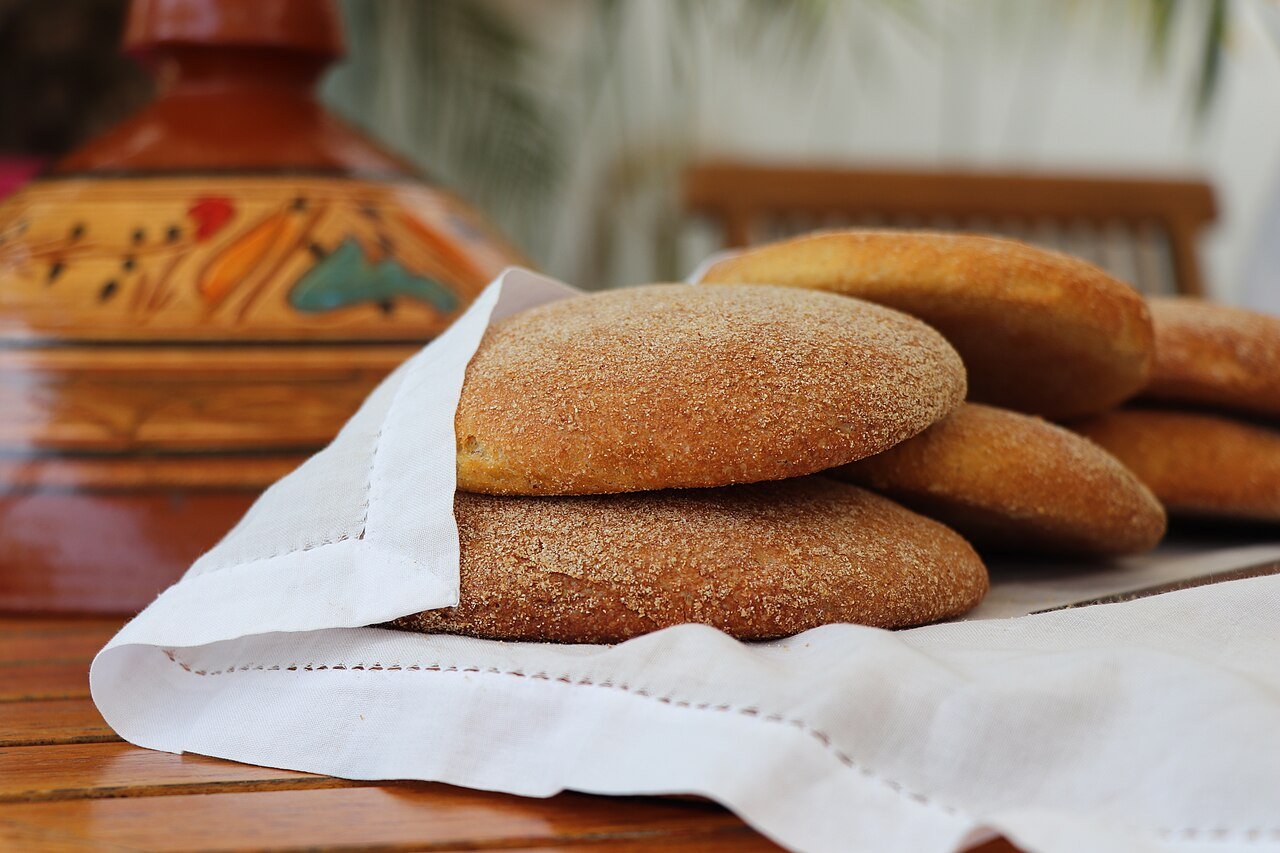
Types of Moroccan Bread You Should Know
Khobz is the daily loaf, but every region and every time of day has its own favorite. Here are ten types of Moroccan bread you will meet in homes, bakeries and street stalls.
Khobz
The round oven loaf baked daily. Made with white flour, semolina, whole wheat or a blend, often with anise or sesame on top.
Batbout
Small, thick rounds cooked in a dry pan until they puff. Split open, they make perfect pockets for fillings.
Msemen
Square, flaky flatbread made by folding oiled, semolina-dusted dough many times, then cooking it on a griddle.
Meloui
A cousin of msemen, rolled into a rope, coiled and flattened into a round for a buttery, spiraled texture.
Harcha
A thick, crumbly pan bread made from coarse semolina, butter and milk. Somewhere between a biscuit and cornbread.
Baghrir
The “thousand-hole” semolina pancake, cooked on one side only and soaked in honey butter.
Tafarnout
A rustic Amazigh bread from the south, baked on hot pebbles inside a clay oven, which leaves it dimpled and smoky.
Khobz sha’ir
Barley bread, once a staple in the countryside. Dense, earthy and very filling, often mixed with some wheat flour.
Krachel
Soft brioche-like buns flavored with anise, sesame and orange blossom water, served with tea or coffee.
Medfouna
The “buried” bread of Rissani: dough filled with spiced meat, onions and egg, then baked. Sometimes called Berber pizza.
Flour and Seeds for Moroccan Bread
The classic texture of Moroccan bread comes from blending flours. White flour gives softness and rise, while semolina or whole wheat adds a pale yellow color, a slightly sandy bite and a nutty taste.
Semolina
Fine durum wheat semolina is the signature of many Moroccan bread recipes. Use fine rather than coarse for khobz, and keep coarse semolina for dusting the tray or making harcha.
Whole wheat and barley
Whole wheat khobz is popular at home and is considered the healthier choice. Barley flour shows up in rural loaves, usually mixed with wheat so the dough still rises.
Yeast, salt and oil
Instant dry yeast is the modern standard. A spoon of olive oil softens the crumb, and a little sugar helps the yeast get going.
Seeds and spices
Whole anise seed is the most traditional flavor. Sesame, fennel and nigella are common too, either kneaded into the dough or pressed on top.
Which Moroccan bread flour blend should you use?
| Blend (for 500 g / about 4 cups) | Texture | Flavor | Best for |
|---|---|---|---|
| All white flour | Soft, airy, light | Mild | Beginners, sandwiches |
| Half white, half fine semolina | Tender with a slight crunch | Sweet, buttery wheat | Classic city-style khobz |
| Half white, half whole wheat | Denser, moist | Nutty, earthy | Everyday family loaf |
| Three parts wheat, one part barley | Heavy, close crumb | Rustic, grainy | Soups and bissara |
Our store does not sell flour or semolina, so pick those up at your local supermarket or a Middle Eastern grocer. For the yeast, seeds and spices, browse our baking essentials.
How to Make Moroccan Bread Step by Step
This Moroccan bread recipe makes two round loaves, each about 9 inches across. It uses half white flour and half fine semolina for the classic crumb, and you need no special equipment.
Ingredients
- 250 g (2 cups) all-purpose or bread flour
- 250 g (about 1 1/2 cups) fine semolina, or whole wheat flour
- 2 tsp instant dry yeast
- 1 1/2 tsp fine salt
- 2 tsp sugar
- 2 tbsp olive oil
- About 1 1/4 cups (300 ml) warm water, around 105°F
- 1 tsp whole anise seeds (optional)
- 1 tbsp sesame seeds for the top, plus coarse semolina or cornmeal for the tray
You will need
- A large bowl or stand mixer with a dough hook
- A large baking sheet
- Two clean kitchen towels
Method
- Mix the dry ingredients. Whisk the flour, semolina, yeast, salt, sugar and anise seeds in a large bowl.
- Add oil and water. Pour in the olive oil and most of the warm water. Mix into a shaggy dough, adding water a spoonful at a time until no dry flour remains.
- Knead well. Knead for 8 to 10 minutes by hand (5 to 6 minutes in a mixer) until smooth, soft and slightly tacky. Semolina dough feels a little sandy at first; it smooths out as it works.
- Shape the loaves. Divide the dough in two and form each piece into a tight ball. Rest 5 minutes, then flatten each ball into a disc about 7 inches wide and 3/4 inch thick.
- Rise. Place the discs on a tray dusted with semolina, brush the tops with water and sprinkle with sesame. Cover with towels and let rise 45 to 60 minutes until puffy.
- Preheat. About 20 minutes before baking, heat the oven to 435°F (225°C) with a rack in the lower third.
- Dock and bake. Prick each loaf a few times with a fork so it does not balloon. Bake 20 to 25 minutes until golden and hollow-sounding when tapped underneath.
- Cool in a towel. Wrap the hot loaves in a clean towel for 15 minutes. This keeps the crust soft, just like a Moroccan home kitchen.
The Ferran: Morocco’s Communal Bread Oven
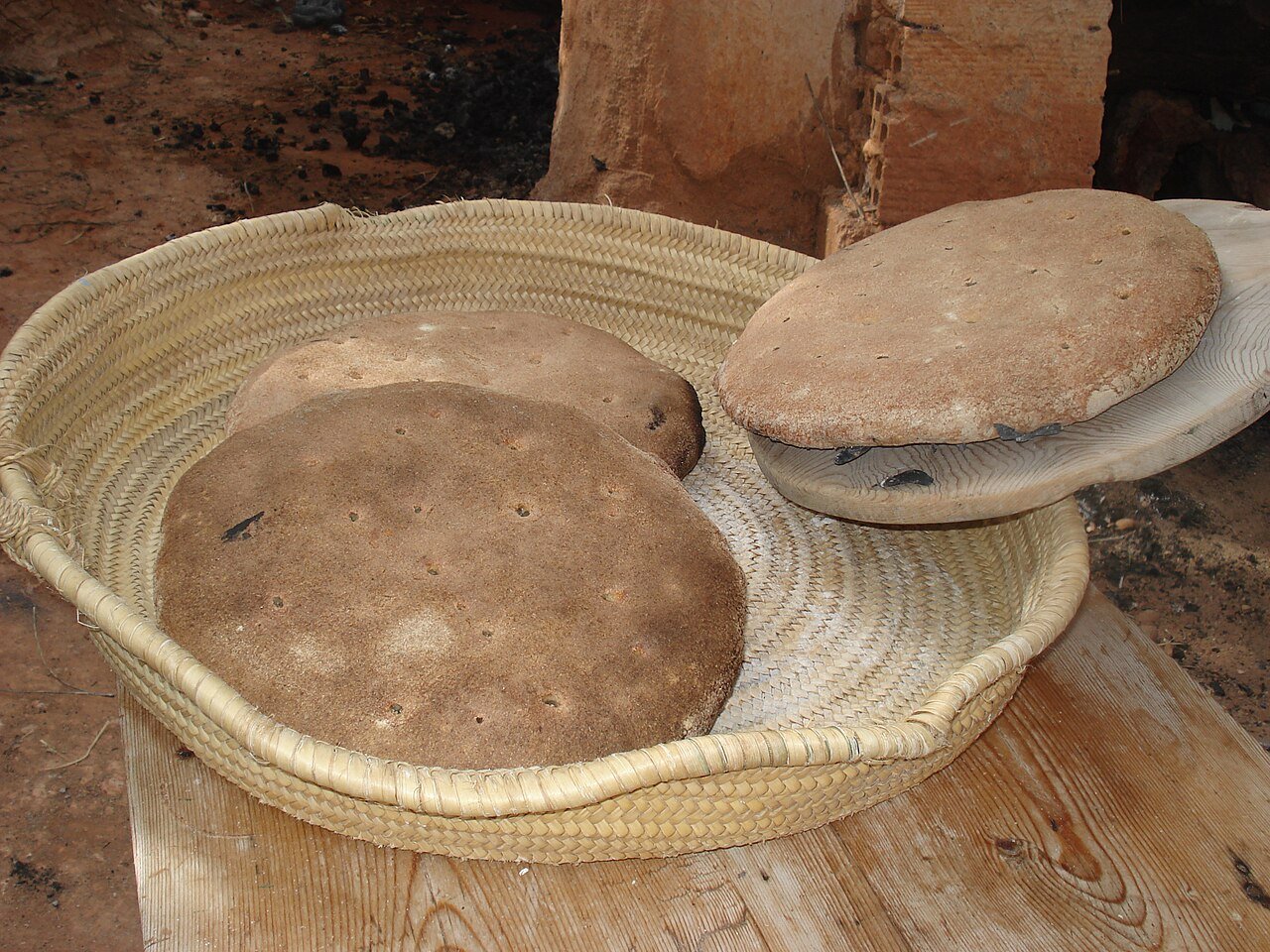
In older neighborhoods, many families still do not bake at home. Instead, they knead the dough, shape it on a cloth-lined wooden tray and send it to the ferran, the wood-fired neighborhood oven. A child or a family member drops it off in the morning and picks it up an hour or two later.
The baker, called the ferran too, works in front of a deep oven with a long wooden peel. Bakers start soon after dawn and turn out hundreds or even thousands of loaves a day. Each family marks its dough, and the baker learns to recognize every household’s Moroccan bread by its shape, seeds or a small dimple.
The fee is tiny, often a coin or two per loaf. The same oven often roasts trays of almonds, cookies for Eid and, in some cities, sits next to the hammam furnace that slowly cooks tanjia. The Milk Street story on Moroccan flatbread describes a ferran baking at about 570°F.

Recreating the ferran effect at home
A home oven cannot reach the heat of a wood-fired ferran, but you can get close. Preheat the oven fully, bake on the lower rack, and use a pizza stone or steel if you have one. A pan of hot water on the bottom rack for the first 10 minutes keeps the crust thin and soft.
Batbout: Moroccan Bread Made in a Pan
Batbout (also called mkhamar) uses almost the same dough as khobz, but it is rolled thin, cut into small rounds and cooked in a dry skillet. As each side sets, steam builds inside and the bread puffs like a pillow.
How to make batbout from the khobz dough
After the first rise, roll the dough about 1/4 inch thick and cut it into 4-inch circles. Let them rest 20 minutes under a towel. Cook in a heavy, ungreased pan over medium heat for about 2 minutes per side, flipping several times, until puffed and lightly spotted.
Batbout is the Moroccan answer to pita. Split it while warm and fill it with grilled kefta, tuna salad, eggs or cheese. Kids love mini batbout at parties and in lunch boxes.

Moroccan Bread Tips and Common Mistakes
Most problems with homemade Moroccan bread come down to water, kneading and heat. These tips fix the usual issues.
Add water slowly
Semolina absorbs water more slowly than flour. Hold back a little and add it in spoonfuls after a minute of mixing.
Knead long enough
Under-kneaded dough tears and bakes dense. Keep going until the dough is smooth and springs back when pressed.
Check the water temperature
Water hotter than about 120°F can kill yeast. Lukewarm to the touch, around 105°F, is right.
Keep the loaf flat
Khobz should be wide, not tall. Press the disc out to 3/4 inch before rising and it will bake to about 1 inch.
Do not over-proof
If the loaves rise too long they collapse when docked. Bake when puffy and a fingertip dent springs back slowly.
Dock with a fork
A few pricks stop the loaf from ballooning like pita and keep the crumb even.
Use high heat
A fully preheated oven at 425 to 450°F gives color fast without drying the inside.
Wrap while hot
A towel traps steam, so the crust softens and the Moroccan bread stays tender for hours.
How to Serve Moroccan Bread
Khobz goes with almost everything. These are three classic ways to enjoy Moroccan bread from morning to night.
Olive oil, honey and olives
Warm wedges dipped in fruity olive oil, then in honey or fig jam, with a handful of oil-cured olives and a glass of mint tea.
Tagines and salads
Moroccan bread is the scoop for tagines, zaalouk and taktouka. It also soaks up the sauce left in the pot, which many say is the best part.
Sardine and harissa sandwiches
Split a loaf, spread a little harissa, add canned sardines, tomato and olives. It is a popular quick lunch across Morocco.

For the mint tea that goes with breakfast bread, see our tea time collection of Moroccan green teas. Our Moroccan cooking oils include fruity olive oils that are made for dipping.
Storing, Reheating and Nutrition
Fresh Moroccan bread is at its best on the day it is baked. Because it has little fat and no preservatives, it dries out faster than supermarket sandwich bread.
| Method | How long | How to |
|---|---|---|
| Room temperature | 1 to 2 days | Wrap in a cloth, then put in a paper or plastic bag |
| Freezer | Up to 2 months | Cut into quarters, wrap tightly and freeze |
| Reheat whole | 8 to 10 minutes | Sprinkle with water and warm at 350°F |
| Reheat wedges | 1 to 2 minutes | Toast in a dry skillet or over a gas flame |
Leftover ideas
Stale khobz makes excellent breadcrumbs for kefta and stuffed vegetables. You can also cut it into cubes, toast them in olive oil and cumin, and scatter them over harira or lentil soup.
Is Moroccan bread healthy?
Moroccan bread is a simple loaf of flour, water, yeast, salt and a little oil. Versions made with whole wheat or barley contain more fiber than all-white loaves, and semolina is made from durum wheat. Like any bread, it contains gluten and is mostly carbohydrate, so portion size matters if you watch your carbs.
Best Moroccan Bread Ingredients to Buy in the USA
The pantry items below help you bake and serve Moroccan bread the authentic way. Pair them with flour and semolina from your local store.
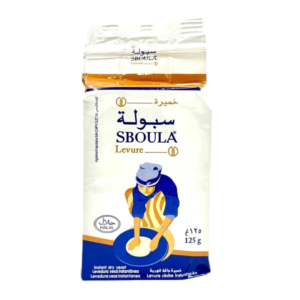 For the doughSboula Instant Dry Yeast
The yeast many Moroccan home bakers use, in a handy 125 g pack.
Shop now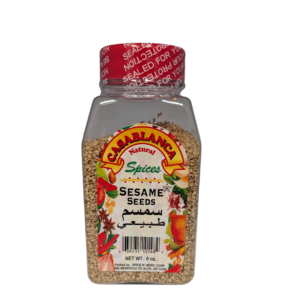

 For dippingMina Extra Virgin Olive Oil
Fruity Moroccan oil for the dough and the breakfast plate.
Shop now
Prefer whole anise in your loaf? Try Casablanca anise seeds. We ship to all 50 states; see our shipping policy for delivery times.
Moroccan Bread FAQs
What is Moroccan bread called?
The everyday Moroccan bread is called khobz, which simply means bread in Arabic. Other types have their own names, such as batbout, msemen, harcha and baghrir.
What is Moroccan bread made of?
Khobz is made from flour, water, yeast and salt, usually with a little sugar and olive oil. Many recipes mix white flour with fine semolina or whole wheat, and some add anise, sesame or fennel seeds.
Is Moroccan bread the same as pita?
No. Khobz is thicker and does not form a pocket because it is docked before baking. Batbout, the pan-cooked version, is closer to pita because it puffs and can be split open.
Can I make Moroccan bread without semolina?
Yes. Use all white flour for a softer loaf, or half white and half whole wheat for a nutty, everyday version. The crumb will be less golden and slightly less crunchy than a semolina loaf.
What temperature do you bake Moroccan bread?
Bake khobz in a fully preheated oven at about 425 to 450°F (220 to 230°C) for 20 to 25 minutes, on a lower rack, until golden and hollow-sounding underneath.
Why is my Moroccan bread dense?
The usual causes are too little water, short kneading, old yeast or an underheated oven. Make a soft, slightly tacky dough, knead for 8 to 10 minutes and let the loaves rise until clearly puffy.
How do Moroccans eat bread?
Moroccans tear bread by hand and use it instead of a fork to scoop tagines, salads and dips. It is also eaten at breakfast with olive oil, honey, jam, cheese or olives and mint tea.
How long does Moroccan bread stay fresh?
It is best the day it is baked and keeps 1 to 2 days wrapped at room temperature. For longer storage, freeze it in quarters for up to 2 months and reheat in the oven or a dry pan.
Further reading: The Breads of Morocco (The Perfect Loaf) · Milk Street: Moroccan seeded flatbread · Moroccan cuisine (Wikipedia)
Bake Your First Khobz This Weekend
Stock up on yeast, seeds and olive oil, and bring the smell of a Moroccan bakery into your kitchen.
Shop Baking Essentials Shop All Products